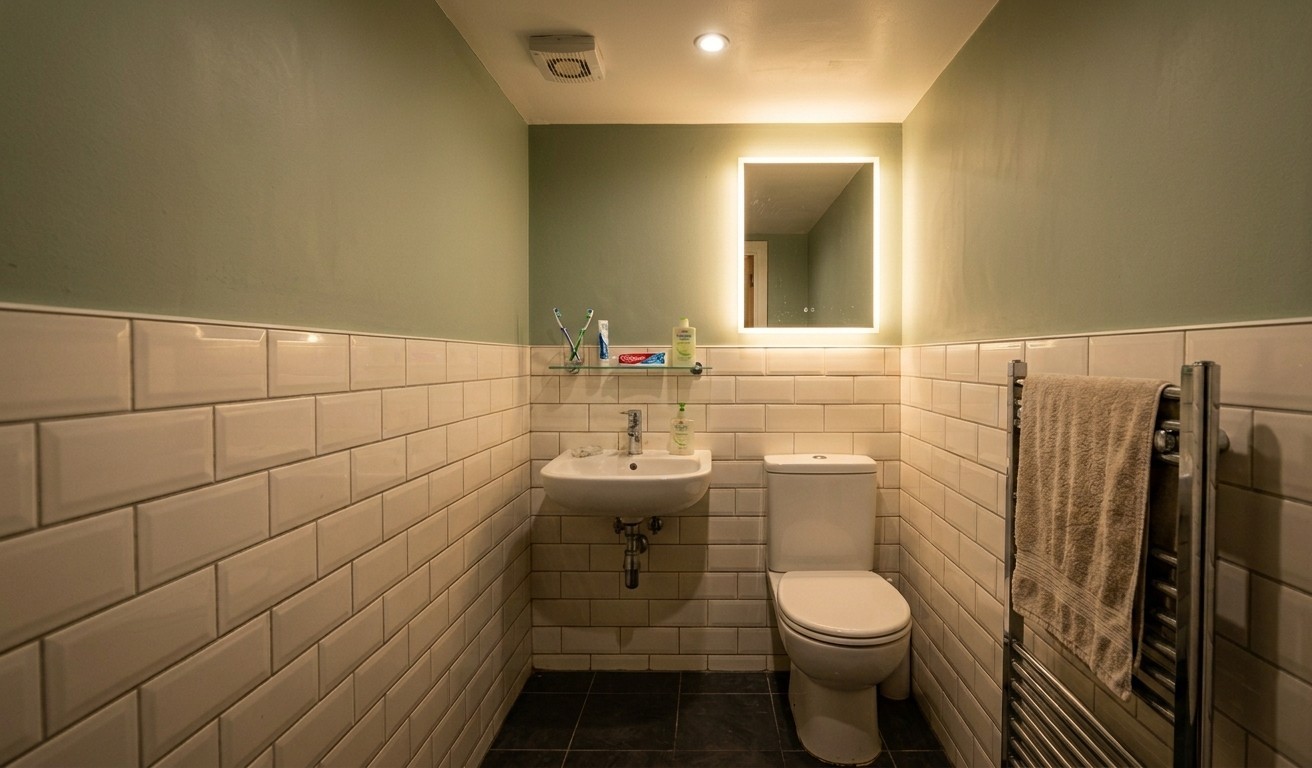
There is a particular kind of despair that sets in when you walk into your bathroom, flick on the pull-cord light, and are immediately greeted by that smell. You know the one. It sits somewhere between “old sports kit” and “the basement of a Victorian library” – earthy, faintly sour, and stubbornly persistent no matter how many aerosol cans of tropical breeze you point at it. If your bathroom has no window, that smell is practically a fixture.
London flats, particularly those in converted Victorian and Edwardian properties, are famously generous with charm and considerably less generous with ventilation. Windowless bathrooms are extraordinarily common across the city, and the damp smell that develops in them is not a sign of personal failure or poor housekeeping. It is, however, entirely solvable. The smell has specific causes, each with a specific remedy, and working through them methodically will transform even the most aggressively musty bathroom into something you are no longer vaguely embarrassed about when guests visit.
Why Windowless Bathrooms Smell the Way They Do
Moisture, Microbes, and the Problem of Nowhere to Go
Every time someone showers, bathes, or runs the hot tap in a windowless bathroom, a significant quantity of warm, humid air is produced and then has absolutely nowhere to go. In a bathroom with even a modest window, leaving it ajar for ten minutes after a shower does the job. In a windowless bathroom, that moisture simply circulates, cools, and settles on every available surface – tiles, grout lines, ceilings, the back of the toilet cistern, the underside of the bath panel – and begins to do what moisture invariably does when left undisturbed: it feeds things.
The primary culprits behind that distinctive damp smell are mould and mildew, both of which release microbial volatile organic compounds – MVOCs – as they grow and metabolise. These compounds are precisely what your nose registers as that musty, earthy odour. The second major contributor is bacteria, particularly the kinds that thrive in warm, persistently moist conditions around drains, grout lines, and bath sealant. Neither mould nor bacteria are visible in their earliest stages, which is why the smell almost always appears before any discolouration does. By the time you can see the problem, the smell has long since settled in and made itself comfortable.
Find the Source Before You Reach for the Spray
Mould, Mildew, Drains, or All Three?
Tackling a damp smell without identifying its source is like taking paracetamol without finding out why you have a headache – you might feel marginally better for a while, but nothing of substance is actually resolved. Before anything else, do a methodical inspection of the room.
Check the silicone sealant around the bath and shower tray first. Discoloured, pink-tinged, or visibly deteriorating sealant is almost always harbouring bacteria and mould within its surface, and it will continue generating odour regardless of how thoroughly you clean everything else around it. Check the grout lines next, particularly in the shower area and along the floor perimeter where water pools longest. Then look up – a windowless bathroom ceiling is ground zero for condensation, and black mould patches above the shower zone are an extremely common and frequently overlooked odour source.
Get down and smell the drain directly after running the shower. A partially blocked drain with an accumulation of hair, soap scum, and organic debris is a powerful and independent odour source that has nothing to do with mould, and it will not respond to mould treatments. Finally, examine the extractor fan grille. A clogged, underperforming, or non-functional extractor is the root cause of more windowless bathroom damp-smell complaints than any other single factor, and addressing it resolves more than any number of air fresheners ever will.
The Deep Clean That Changes Everything
Addressing the Problem at Its Source
Once you know where the smell originates, you can clean with purpose rather than optimism. Here is the sequence we follow in professional bathroom cleans.
Mould on ceilings and walls responds well to a solution of equal parts white vinegar and water, applied with a spray bottle and left to dwell for ten minutes before wiping away with a microfibre cloth. For established mould on non-porous surfaces, a specialist mould remover spray containing benzalkonium chloride is more effective and provides longer-lasting suppression. Always work with the extractor fan running and the bathroom door open where possible.
Grout lines are best treated with a bicarbonate of soda paste – combined with a small amount of washing-up liquid for extra surfactant action – or a dedicated grout cleaner that specifically states mould resistance. Apply generously, allow fifteen minutes of dwell time, scrub with a soft-bristle brush worked along the joint rather than across it, then rinse thoroughly.
Silicone sealant that has gone pink or black beneath the surface cannot be cleaned back to health. It needs removing entirely with a silicone remover tool or a sharp craft knife, the underlying surface allowed to dry completely for at least twenty-four hours, and then replaced with a fresh bead of anti-mould bathroom silicone. This single step eliminates one of the most persistent odour sources in any bathroom and is invariably among the first things we address on a first-time professional clean.
Drains should be cleared of any visible blockage first, then treated with a biological drain cleaner – the enzyme-based type, not the caustic variety – which breaks down the organic material responsible for drain odour without corroding pipework or disturbing any older plumbing joints common in London’s Victorian housing stock.
Ventilation – The Root Cause You Cannot Ignore
Making the Most of What You’ve Got
No amount of cleaning will permanently resolve a damp smell in a windowless bathroom if the underlying ventilation problem is not addressed alongside it. Moisture has to go somewhere, and in the absence of a window, the extractor fan carries the entire burden.
Building regulations in England require that a windowless bathroom has mechanical ventilation capable of at least fifteen litres of air exchange per second. In practice, many London flats – particularly older conversions – have fans that are undersized, poorly installed, or have not been cleaned or serviced since the property was last refurbished. Remove the grille and clean the fan blades with a dry cloth or vacuum brush attachment. If the fan is visibly struggling, making unusual noises, or more than a decade old, replacing it is one of the most cost-effective improvements any London flat-dweller can make to their bathroom environment.
A humidity-sensing extractor fan – one that detects moisture levels automatically and continues running until the air is genuinely dry – is a meaningful upgrade over a basic timer-controlled model. They are widely available for under £50 and require no behavioural change from the user whatsoever, which makes them particularly effective. Do also verify that your duct actually vents to the outside rather than into a loft void or a neighbouring cavity – a more common installation failure than it ought to be, and one that renders even the best extractor fan completely useless.
Odour Absorbers – What Actually Works
Beyond the Plug-In Air Freshener
Air fresheners mask odour. Odour absorbers eliminate it. Understanding the difference will save money and spare your bathroom from the particular olfactory horror of damp smell mixed with synthetic mango.
Activated charcoal bags are the most effective passive absorber available. They work by adsorption – trapping odour molecules within a vast network of microscopic pores – rather than simply layering fragrance over the problem. A bag placed on the bathroom shelf or on top of the cistern will produce a noticeable improvement in background odour within a week. They can be regenerated by placing them outdoors in direct sunlight for a couple of hours once a month, which is extremely satisfying in a low-key way.
Bicarbonate of soda in an open bowl works on the same principle at considerably lower cost, though it needs replacing every four to six weeks. Both options are far preferable to plug-in or aerosol alternatives, which address nothing structural and tend to create a second smell problem layered onto the first.
Keeping the Smell From Coming Back
Daily and Weekly Habits Worth Keeping
Prevention, as with most things in a bathroom, requires considerably less effort than cure. The habits that keep a windowless bathroom smelling genuinely clean are not complicated – they simply need to become automatic.
Run the extractor fan for at least twenty minutes after every shower or bath, not merely for its duration. The moisture generated by a ten-minute shower takes far longer than ten minutes to clear from an enclosed space. If your fan is wired to the light switch, a simple timer override – an inexpensive addition available at any hardware shop – lets it continue running after the light goes off.
Wipe down shower walls and the bath surface with a squeegee or a dry cloth after each use. This sounds like advice from someone who has never experienced a tired Tuesday morning, but it makes a genuine and measurable difference to the overnight moisture load the room is left to manage.
Finally, a weekly spray of diluted tea tree oil solution – roughly twenty drops to 500ml of water in a spray bottle – applied to grout lines, sealant edges, and the ceiling above the shower acts as a mild antifungal that prevents mould from re-establishing itself between deeper cleans. Tea tree oil carries a faint air of a 1990s health food shop, and nobody is pretending otherwise. But it works, it is entirely safe on bathroom surfaces, and it costs almost nothing.